Online Therapy in New York
Personalized Virtual Therapy for Adults & Couples Throughout New York State
Life doesn't always leave much room to slow down. Between work, relationships, family responsibilities, and the expectations we place on ourselves, finding time and space to prioritize your mental health can feel like another thing on an already overwhelming to-do list.
Online therapy offers an opportunity to prioritize your emotional well-being without the additional demands of commuting to an office or rearranging your entire schedule.
At Integro Psychotherapy, I provide online therapy for adults and couples throughout New York State. My approach is warm, collaborative, and integrative, helping individuals navigate anxiety, depression, relationship challenges, perfectionism, burnout, trauma, and major life transitions.
Whether you're looking for support with a specific challenge, navigating a difficult period in your life, or wanting to better understand yourself and your relationships, virtual therapy can provide a meaningful space for reflection, growth, and change.
You don't have to wait until things become unbearable to seek support.
[Schedule a Free 15-Minute Consultation]
What Is Online Therapy?
Online therapy, sometimes called teletherapy or virtual counseling, is psychotherapy provided through video conferencing rather than in a traditional office setting.
The therapeutic process is largely the same as in-person therapy. You'll meet with your therapist for regularly scheduled sessions, explore what's bringing you to therapy, identify patterns, develop coping strategies, and work toward goals that feel meaningful to you.
At Integro Psychotherapy, online sessions are offered throughout New York State, allowing you to participate from a private, comfortable location that works for you.
Virtual therapy can be especially helpful for people who:
Have demanding work schedules or unpredictable routines.
Prefer the comfort and familiarity of their own environment.
Experience anxiety, overwhelm, or difficulty with transitions.
Have limited access to transportation or local mental health services.
Are balancing work, school, caregiving, or parenting responsibilities.
Want consistent therapeutic support while traveling within New York State.
Online therapy isn't about making therapy less personal. It's about finding a way to make meaningful therapeutic work more accessible and sustainable.
Who Is a Good Candidate for Online Therapy?
Online therapy can be a good fit for many adults and couples, including people navigating complex emotional experiences or ongoing mental health concerns.
The appropriateness of virtual therapy depends on several factors, including your current symptoms, safety, treatment needs, support system, access to privacy, and comfort with technology.
Online Therapy May Be a Good Fit If You:
Are experiencing anxiety, depression, or chronic stress.
Virtual therapy can provide a consistent space to explore anxious thoughts, low mood, emotional overwhelm, burnout, and the patterns that contribute to distress. It can also help you develop practical coping strategies and improve emotional regulation.
Are navigating life transitions or relationship challenges.
Major life changes can bring uncertainty, grief, and unexpected emotional challenges. Therapy can help you process these experiences, strengthen communication, establish boundaries, and better understand your needs.
Struggle with ADHD or executive functioning.
For some individuals, attending appointments remotely can reduce the additional organizational demands associated with commuting, navigating unfamiliar environments, and transitioning between responsibilities.
Are managing ongoing mental health symptoms.
People living with conditions such as ADHD, OCD, PTSD, bipolar disorder, or recurrent depression may be appropriate candidates for online therapy when their symptoms and treatment needs can be safely and effectively supported in an outpatient virtual setting.
A diagnosis alone does not determine whether online therapy is appropriate. What matters is how symptoms are currently affecting your functioning, safety, and ability to participate in treatment.
Have an established support system or access to additional care when needed.
Having supportive people, healthcare providers, or other resources available can be helpful when navigating more challenging periods of mental health treatment.
Feel comfortable communicating through video.
You don't need to be particularly tech-savvy. However, being able to participate in video sessions, communicate openly, and access a reasonably private environment can make virtual therapy more effective.
When Might Online Therapy Not Be the Best Fit?
Although online therapy can be effective for many people, it isn't the right level or format of care for every situation.
There are circumstances when in-person treatment, more frequent clinical contact, or a higher level of mental health support may be more appropriate.
Situations That May Require Additional Support Include:
Acute safety concerns or immediate risk.
If you're experiencing active suicidal intent, a recent suicide attempt, an inability to maintain your immediate safety, or an immediate risk of harming someone else, routine outpatient online therapy alone may not provide the level of support you need.
In these situations, an in-person crisis assessment, emergency evaluation, or more intensive treatment may be necessary.
Severe or rapidly escalating symptoms.
Significant changes in mood, severe depressive symptoms, acute manic symptoms, psychosis, or substantial difficulty distinguishing reality may require additional assessment and coordinated care.
These experiences do not automatically exclude someone from virtual therapy, but they may indicate a need for a different treatment setting or additional clinical support.
Difficulty maintaining daily functioning or personal safety.
If symptoms are significantly interfering with your ability to care for yourself, maintain basic routines, or function safely, additional support may be needed beyond regularly scheduled outpatient sessions.
Limited privacy or an unsafe environment.
Therapy requires an environment where you can speak openly without worrying about being overheard, monitored, interrupted, or judged.
If you don't have reliable access to a private space, or your home environment makes it difficult to communicate safely, virtual therapy may present additional challenges.
A need for more intensive or coordinated treatment.
Some individuals benefit from more frequent sessions, intensive outpatient programs (IOP), partial hospitalization programs (PHP), psychiatric evaluation, medication management, or other forms of coordinated mental health care.
In these circumstances, online individual therapy may still be one component of treatment, but it may not be sufficient as the primary source of support.
It's important to remember that needing additional support isn't a personal failure. Finding the appropriate level of care is part of taking your mental health seriously.
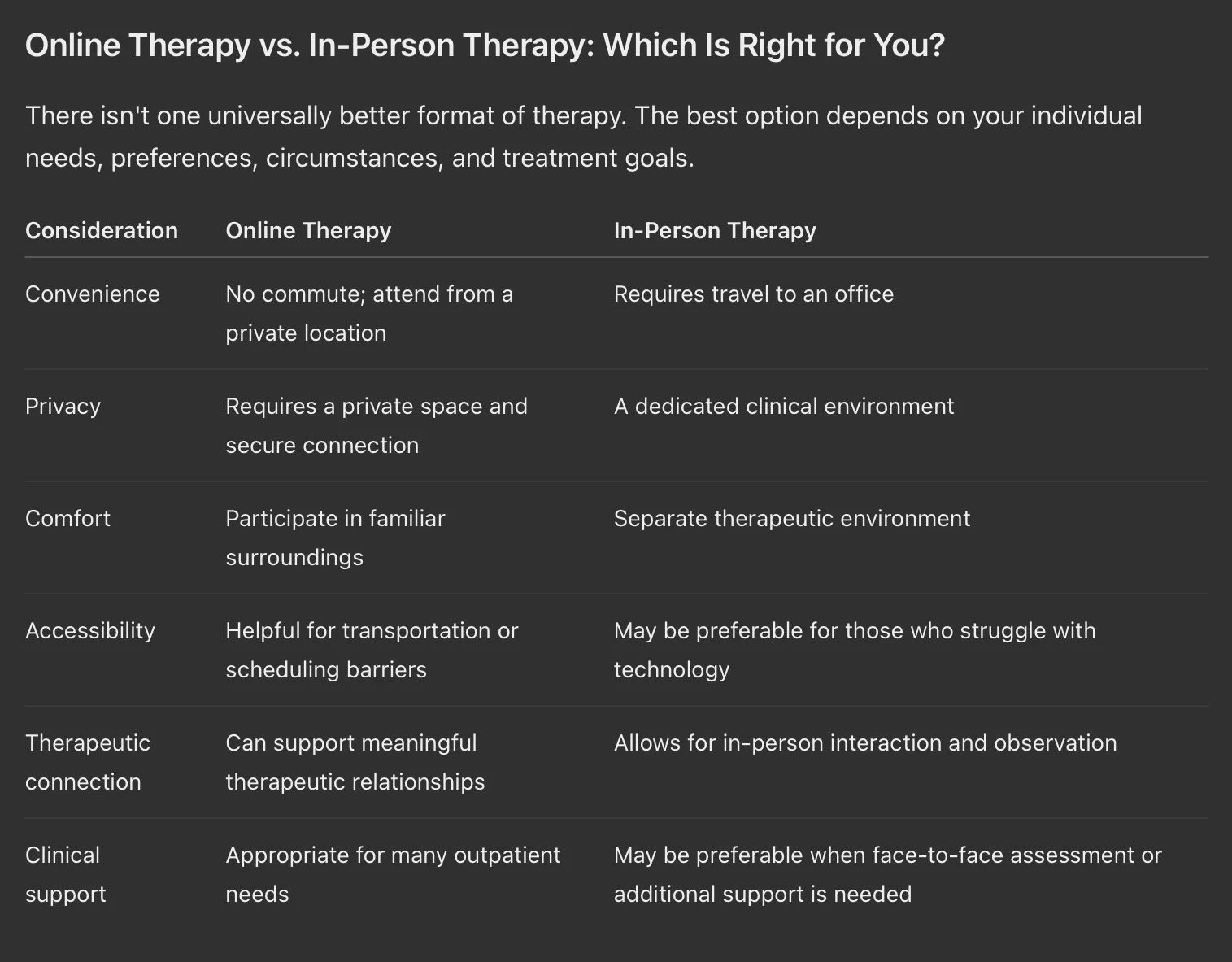
Online Therapy vs. In-Person Therapy: Which Is Right for You?
There isn't one universally better format of therapy. The best option depends on your individual needs, preferences, circumstances, and treatment goals.
Online therapy can be a wonderful option when convenience, accessibility, and consistency are priorities.
In-person therapy may be preferable when someone benefits from physical separation between home and therapy, has difficulty maintaining privacy, or has clinical needs that are better addressed face-to-face.
Ultimately, the format should support the quality and effectiveness of your treatment rather than become another barrier to receiving care.
Privacy and Confidentiality During Online Therapy
One of the most important considerations when participating in virtual therapy is having a space where you feel comfortable speaking openly.
Although online therapy offers flexibility, it also requires some additional attention to privacy.
Before beginning sessions, consider whether you have access to:
A private room where conversations cannot be overheard.
A reliable internet connection.
Headphones to reduce the possibility of others hearing your conversation.
A device with appropriate security and password protection.
A location where you feel physically and emotionally comfortable.
If you live with roommates, family members, or a partner, finding a consistent time and space for therapy may require some planning.
Your privacy matters. Therapy should be a space where you can speak honestly about your experiences without worrying about who might be listening.
Sessions are conducted through a secure, HIPAA-compliant video platform.
What Can You Work on in Online Therapy?
Virtual therapy isn't limited to addressing everyday stress or situational concerns. Depending on your clinical needs and the appropriateness of outpatient treatment, online therapy can support a wide range of mental health and personal growth goals.
At Integro Psychotherapy, areas of focus include:
Anxiety and chronic stress
Depression and mood concerns
ADHD and executive functioning
Perfectionism and self-esteem
Trauma and difficult childhood experiences
Relationship challenges and codependency
Emotional regulation and boundaries
Burnout and work-related stress
OCD and unwanted thought patterns
Life transitions, grief, and loss
Pregnancy, postpartum, and fertility-related concerns
Therapy is individualized rather than diagnosis-driven. You don't need to arrive with a clear explanation or a specific label for what you're experiencing.
Together, we can explore your experiences, understand the patterns contributing to your distress, and develop an approach that reflects your needs and goals.
What Is Online Therapy Like at Integro Psychotherapy?
I believe therapy works best when it feels collaborative, personalized, and grounded in a genuine therapeutic relationship.
My approach integrates Cognitive Behavioral Therapy (CBT), Narrative Therapy, IFS, Dialectical Behavior Therapy (DBT) skills, and other insight-oriented and experiential approaches.
Depending on your needs, our work may include:
Identifying thinking patterns and limiting beliefs.
Exploring how childhood experiences and relationships influence present-day patterns.
Developing emotional regulation and distress tolerance skills.
Strengthening boundaries and communication.
Understanding relationship dynamics and attachment patterns.
Exploring identity, values, and personal narratives.
Building practical strategies for navigating everyday challenges.
Even through a screen, therapy can be a space for meaningful connection, vulnerability, humor, reflection, and growth.
My goal is to create an environment where you feel comfortable being yourself while also having the opportunity to challenge patterns, develop new perspectives, and create meaningful changes in your life.
Creating Space to Transition In and Out of Therapy
One thing I pay particular attention to in virtual therapy is how you transition back into your day after a session.
Therapy can bring up vulnerable, emotionally activating, or unexpected material. Unlike traditional in-person therapy, where you may have a commute or some physical distance between the therapy office and the rest of your day, online therapy often means returning immediately to your usual environment.
When we're exploring something particularly difficult or emotionally activating, I try to leave a few minutes at the end of our session to help you regulate, reconnect with the present moment, and feel more grounded before we wrap up. I keep in mind that you may have a work meeting, caregiving responsibilities, or other obligations waiting for you immediately afterward.
We can also explore small rituals or routines to help create a sense of transition before and after therapy. This might look like taking a few minutes to settle in before logging on, making a cup of tea, journaling, taking a short walk, listening to music, or giving yourself a little time to decompress after a session.
These practices aren't one-size-fits-all, and they won't necessarily be helpful or realistic for everyone. The goal isn't to add another obligation to your day, but to find small, individualized ways to make space for yourself and support the transition into and out of therapeutic work.
You deserve time to process what comes up in therapy without feeling like you have to immediately switch gears and carry on as though nothing happened.
Online Therapy Throughout New York State
I provide virtual psychotherapy to adults and couples throughout New York State.
Whether you're in New York City, Brooklyn, Queens, Manhattan, the Bronx, Staten Island, Long Island, Westchester, or elsewhere in New York, you can access therapy without needing to commute to a physical office.
Online therapy can make it easier to maintain consistency during busy workweeks, life transitions, or periods when getting to an office feels like an additional challenge.
Please note: You must be physically located in New York State when attending sessions, subject to applicable licensure and practice requirements.
Frequently Asked Questions About Online Therapy
Is online therapy as effective as in-person therapy?
Online therapy can be an effective form of outpatient psychotherapy for many people. Research supports virtual treatment for a range of mental health concerns, although effectiveness depends on individual needs, treatment approach, clinical circumstances, and the therapeutic relationship.
Online therapy isn't necessarily better or worse than in-person therapy. The goal is to determine which format best supports your treatment.
Can I participate in online therapy if I have a mental health diagnosis?
Yes. Having a mental health diagnosis does not automatically make you ineligible for online therapy.
People experiencing ADHD, anxiety, depression, OCD, PTSD, bipolar disorder, and other mental health concerns may be appropriate candidates for virtual outpatient treatment.
The decision depends on your current symptoms, clinical needs, safety, and whether online therapy can provide an appropriate level of care.
What if I'm experiencing severe anxiety or depression?
You don't have to be feeling well to begin therapy. Many people seek support because their symptoms have become difficult to manage.
The important distinction is whether your current needs can be safely and effectively addressed through regularly scheduled outpatient sessions or whether additional support is necessary.
We can discuss your circumstances during an initial consultation and determine whether virtual outpatient therapy is an appropriate starting point.
What if I don't have complete privacy at home?
Privacy is an important part of the therapeutic process. If you share your living space, we can discuss whether there are practical ways to create a private environment.
If consistent privacy isn't possible, we can explore whether another location or format would better support your participation.
Do I need to live in New York City to work with you?
No. I provide online therapy to adults and couples throughout New York State. You can participate from anywhere in the state as long as you meet the applicable location and eligibility requirements.
Do you offer online couples therapy?
Yes. Virtual couples therapy offers partners an opportunity to work on communication, conflict resolution, relationship patterns, intimacy, and strengthening their connection.
Both partners must be able to participate in a private and appropriate setting.
How long are online therapy sessions?
Sessions are 50 minutes and take place through video conferencing.
How do I get started?
The first step is scheduling a free 15-minute video consultation.
We'll discuss what brings you to therapy, answer your questions, and explore whether we're a good fit to work together.
If we decide to move forward, we'll discuss scheduling, insurance, and the next steps for beginning treatment.
You Don't Have to Navigate Everything on Your Own.
Whether you're feeling overwhelmed, stuck in familiar patterns, navigating a major life transition, or simply looking for a space to better understand yourself, therapy can be an opportunity to slow down and reconnect with what matters.
You deserve support that recognizes the complexity of your experiences, respects your individuality, and meets you where you are.
Online therapy makes it possible to begin that work from wherever you feel most comfortable throughout New York State.
Ready to Get Started?
Schedule a free 15-minute consultation to learn more about working together.
[Schedule Your Free Consultation]
Integro Psychotherapy
Katie L. Callihan, M.A., LMHC