CBT: Understanding Triggers, Automatic Thoughts & Core Beliefs
Exploring the connection between what happens, what we think, and how we feel
Have you ever found yourself reacting strongly to a situation and wondered why it affected you so much? Maybe someone didn't respond to a text, a coworker offered feedback, a partner seemed distant, or you made a mistake at work. Although the situation itself might seem relatively small, your emotional response may feel overwhelming, familiar, or difficult to shake.
Cognitive Behavioral Therapy (CBT) offers a framework for understanding these experiences by exploring the relationship between our thoughts, emotions, physical sensations, and behaviors.
Often, our reactions are influenced not only by what is happening in the present, but also by the meaning we assign to an experience. Our brains make quick interpretations based on previous experiences, learned expectations, relationships, and beliefs about ourselves, other people, and the world.
This worksheet can help you slow down those moments and become curious about what is happening beneath the surface.
Why Understanding Triggers Matters
A trigger is an experience, interaction, memory, or situation that activates an emotional or physical response. Triggers can be obvious, but they can also be subtle and difficult to recognize.
For example:
Receiving criticism or feedback.
Feeling ignored, excluded, or misunderstood.
Someone expressing disappointment or frustration.
Making a mistake or not meeting your own expectations.
Experiencing uncertainty or feeling out of control.
Having a boundary questioned or dismissed.
Feeling rejected, abandoned, or unappreciated.
Sometimes our reactions are connected to the present situation. Other times, an experience may activate an older emotional association, reminding us of something we have experienced before.
Understanding your triggers can help you recognize patterns rather than simply judging yourself for having a reaction.
Instead of asking, "Why am I being so sensitive?" you might begin asking, "What about this situation feels familiar, threatening, or important to me?"
What Are Automatic Thoughts?
Automatic thoughts are the quick interpretations, assumptions, or internal messages that arise in response to an experience. They often happen so quickly that we may not recognize them as thoughts at all. We may experience them as facts.
For example:
Situation: Your partner is quieter than usual.
Automatic thought: "They're upset with me."
Emotion: Anxiety, fear, or insecurity.
Behavior: You repeatedly ask if something is wrong, withdraw, or become defensive.
The automatic thought may feel convincing, but it is still an interpretation—not necessarily an accurate reflection of what is happening.
Other examples include:
"I always mess things up."
"They're probably disappointed in me."
"If I say no, they'll stop liking me."
"I should be able to handle this."
"I'm falling behind everyone else."
"Something bad is going to happen."
"If I make a mistake, people will think I'm incompetent."
Learning to identify automatic thoughts creates an opportunity to examine them rather than immediately accepting them as facts.
How Do Core Beliefs Influence Our Reactions?
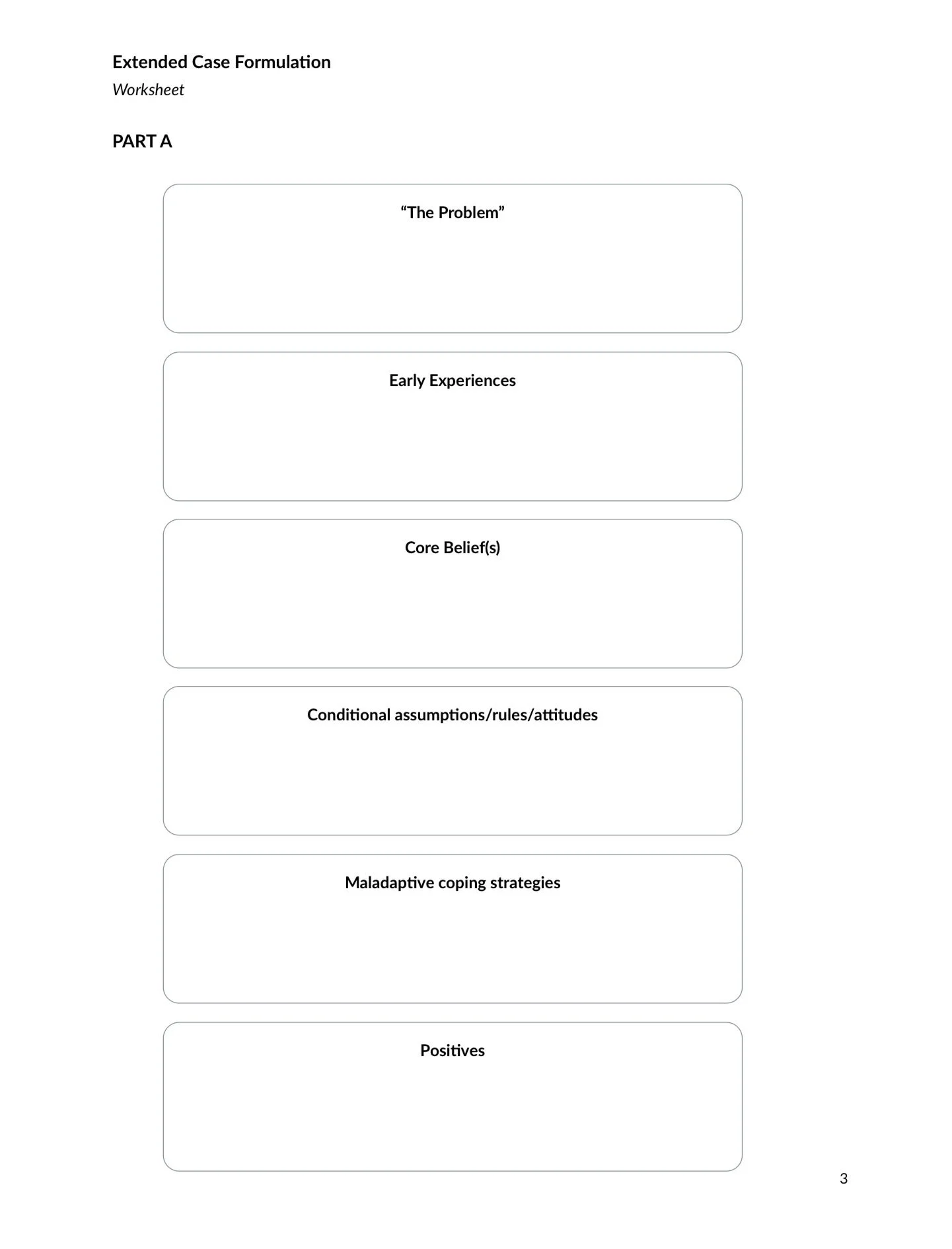
Core beliefs are deeper, often long-standing beliefs about ourselves, other people, and the world. They can develop through childhood experiences, family dynamics, cultural messages, relationships, and significant life events.
These beliefs can influence how we interpret situations and which automatic thoughts show up.
For example:
Core belief: "I'm not good enough."
Trigger: Receiving constructive feedback at work.
Automatic thought: "My supervisor thinks I'm incompetent."
Emotion: Shame, anxiety, or embarrassment.
Behavior: Overworking, avoiding feedback, becoming defensive, or seeking reassurance.
Some common core beliefs include:
I'm not good enough.
I'm unlovable or difficult to love.
I'm responsible for everyone else's happiness.
I cannot trust other people.
My needs are a burden.
I have to be perfect to be accepted.
The world is unpredictable or unsafe.
I have to stay in control to feel secure.
These beliefs are not necessarily conscious, and they may have developed as ways of understanding or navigating earlier environments. Sometimes they helped us feel safe, maintain connection, or make sense of experiences we did not have the resources to understand at the time.
The goal is not to blame ourselves for developing these beliefs, but to understand how they may continue to influence our lives.
The CBT Thought Record: Connecting the Pieces
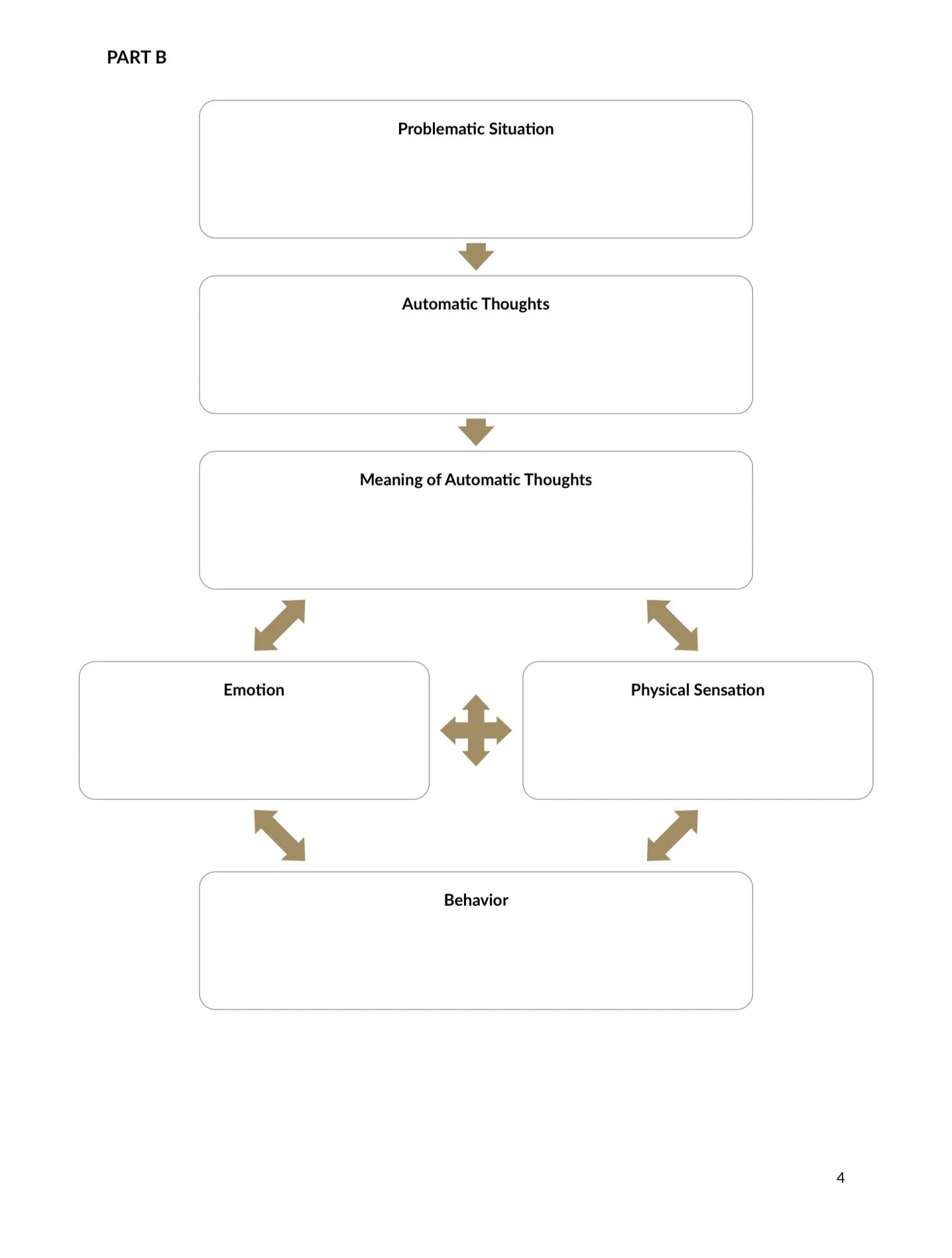
A thought record helps you slow down a specific experience and examine the relationship between different parts of your response.
As you complete the worksheet, consider the following:
Situation or trigger: What happened? Describe the experience as objectively as possible.
Automatic thoughts: What went through your mind? What did you immediately assume or tell yourself?
Emotions: What feelings came up? Try using a feelings wheel to identify more specific emotions.
Physical sensations: What did you notice in your body? For example, tension, a racing heart, a heavy feeling, or restlessness.
Behaviors or urges: What did you do, avoid, or feel compelled to do?
Underlying beliefs: What might this experience seem to confirm about yourself, other people, or the world?
Evidence and alternative perspectives: What supports your interpretation? What information might challenge it? What else could be happening?
A more balanced thought: What is another way to understand the situation that acknowledges your feelings while allowing for additional possibilities?
Why This Work Can Be Helpful
Recognizing the connection between triggers, automatic thoughts, and core beliefs can help you:
Recognize emotional patterns: Notice why certain situations consistently bring up anxiety, shame, anger, insecurity, or sadness.
Understand your reactions: Identify the thoughts and beliefs that may be contributing to an emotional response.
Separate feelings from facts: Acknowledge that an emotion is real without automatically assuming the interpretation attached to it is accurate.
Identify thinking patterns: Recognize tendencies like catastrophizing, mind-reading, all-or-nothing thinking, personalization, or assuming the worst.
Develop self-compassion: Understand that many reactions are connected to learned experiences rather than personal shortcomings.
Create more intentional responses: Develop space between an initial thought and what you choose to do next.
Question beliefs that no longer serve you: Explore whether long-standing assumptions still reflect your experiences, values, and relationships today.
A Few Things to Remember
CBT is not about forcing yourself to think positively, dismissing difficult emotions, or finding a reason why you shouldn't feel the way you do.
Sometimes a situation really is hurtful, unfair, unsafe, or disappointing. The goal is not to talk yourself out of recognizing that. It is to understand the full picture, including the thoughts and beliefs influencing your experience.
You do not have to replace every negative thought with a positive one. Sometimes a more balanced thought is simply a more compassionate, realistic, or flexible way of looking at a situation.
Awareness creates options. The more you understand your internal patterns, the more opportunities you have to respond intentionally rather than automatically.
This worksheet is an educational and self-reflection tool. It is not a substitute for individualized mental health care or a requirement to process difficult experiences without support.
Thinking Mistakes & Thinking Errors Worksheet
Recognizing thought patterns, challenging assumptions, and developing a more balanced perspective
Our thoughts influence how we feel, how we interpret situations, and how we respond to ourselves and others. Sometimes, especially when we're stressed, anxious, overwhelmed, or navigating difficult experiences, our minds fall into familiar patterns that may not tell the whole story.
In Cognitive Behavioral Therapy (CBT), these patterns are often called thinking errors or cognitive distortions.
Having these thoughts doesn't mean something is wrong with you. Many develop as ways of making sense of experiences, anticipating danger, protecting ourselves, or trying to maintain control. The goal isn't to eliminate these thoughts or replace every negative thought with a positive one. Instead, it's to notice them, become curious about them, and consider whether another interpretation might also be possible.
Part 1: Getting to Know Common Thinking Errors
Read through the examples and notice which patterns feel familiar. You may recognize yourself in several of them.
1. All-or-Nothing Thinking
Seeing things in extremes, with little room for the middle ground.
"If I don't do this perfectly, I've completely failed."
"If they're upset with me, our relationship must be falling apart."
"I'm either successful or a failure."
2. Catastrophizing
Assuming the worst possible outcome will happen, even when there is limited evidence.
"If I make a mistake at work, I'll get fired."
"This headache must mean something is seriously wrong."
"If this relationship ends, I'll never find someone else."
3. Mind Reading
Assuming you know what someone else is thinking or feeling without checking.
"They didn't text back because they're annoyed with me."
"Everyone at the party thinks I'm awkward."
"My partner is quiet, so they must be unhappy with me."
4. Fortune Telling
Predicting how something will turn out as if the outcome is already certain.
"I'm going to embarrass myself."
"This conversation isn't going to go well."
"I'm never going to feel better."
5. Overgeneralization
Taking one experience and applying it broadly to other situations.
"I always mess things up."
"People never stick around."
"Nothing ever works out for me."
6. Mental Filtering
Focusing primarily on the negative details while overlooking positive or neutral information.
Receiving ten compliments and focusing on one criticism.
Having a mostly successful day but remembering only one awkward interaction.
Completing a project but focusing exclusively on what could have been better.
7. Discounting the Positive
Dismissing positive experiences, accomplishments, or feedback as unimportant or undeserved.
"They're just being nice."
"Anyone could have done that."
"It wasn't really an accomplishment."
8. Personalization
Taking responsibility for things that may not be entirely within your control.
"My friend is upset, so I must have done something wrong."
"My partner had a bad day because I wasn't supportive enough."
"It's my job to make sure everyone is happy."
9. Emotional Reasoning
Treating feelings as proof that something is objectively true.
"I feel guilty, so I must have done something wrong."
"I feel anxious, so something bad must be happening."
"I feel unlovable, so I must be unlovable."
10. Should Statements
Using rigid expectations about how you, other people, or the world are supposed to behave.
"I should always be productive."
"I shouldn't need help."
"They should know what I need without me asking."
11. Labeling
Defining yourself or another person by a single behavior, mistake, or experience.
"I'm an idiot."
"I'm a failure."
"They're a terrible person."
12. Magnification and Minimization
Exaggerating the importance of negative events while minimizing strengths, successes, or positive experiences.
"That one mistake ruined everything."
"My accomplishments don't really count."
"Their small criticism proves I'm not good enough."
13. Blaming
Assigning responsibility entirely to yourself or someone else without considering the full context.
"Everything is my fault."
"Nothing is ever my responsibility."
"If they hadn't done that, I wouldn't feel this way."
14. Unfair Comparisons
Comparing your internal experience, struggles, or perceived shortcomings with someone else's outward presentation.
"Everyone else has their life together."
"I'm so far behind compared to my friends."
"Other people handle this so much better than I do."
Part 2: Recognizing Your Own Thinking Patterns
Think about a recent situation that brought up a strong emotional reaction.
What happened?
Describe the situation as objectively as possible. What would a camera have captured?
What went through your mind?
Write down the automatic thoughts, assumptions, or interpretations that came up.
What emotions did you experience?
Examples: anxiety, sadness, anger, shame, guilt, embarrassment, disappointment, fear.
How intense were these emotions?
Rate each from 0–100.
What did you notice in your body?
Examples: tight chest, racing heart, tense muscles, stomach discomfort, fatigue.
How did you respond?
Did you withdraw, avoid, over-explain, seek reassurance, become defensive, people-please, or try to regain control?
Which thinking errors might be present?
You can identify more than one. Remember, this is an opportunity for curiosity, not criticism.
Part 3: Challenging the Thought Without Invalidating Yourself
You don't have to convince yourself that everything is okay. Instead, practice making room for additional information and possibilities.
Consider the following questions:
What evidence supports this thought?
What evidence might challenge or complicate this thought?
Am I making an assumption about what someone else thinks or feels?
Am I treating a possibility as if it were a certainty?
Am I focusing on one part of the situation and overlooking the bigger picture?
Would I interpret this situation the same way if it happened to someone I care about?
What information might I be missing?
Is there another explanation that could also be true?
What is within my control, and what isn't?
Can I acknowledge my feelings without treating them as proof?
Part 4: Creating a More Balanced Thought
A balanced thought is not necessarily positive. It is one that considers the available evidence, acknowledges uncertainty, and allows for more than one possibility.
Original automatic thought:
What did your mind initially tell you?
Thinking error(s):
Which patterns might be influencing your interpretation?
Evidence supporting the thought:
What facts or experiences contribute to this belief?
Evidence that complicates the thought:
What information, experiences, or alternative explanations might you be overlooking?
More balanced thought:
What is another way to understand the situation that feels realistic, compassionate, and grounded?
How do you feel now?
Re-rate the intensity of your emotions from 0–100. Your feelings don't have to disappear for this exercise to be useful.
Part 5: Reflection & Building Awareness
Take a moment to reflect on what you noticed.
Which thinking errors do I recognize most often?
Are there particular situations, relationships, or emotions that make these patterns more likely?
Where might I have learned these ways of thinking?
Do these thoughts remind me of messages I received growing up or in past relationships?
How have these thought patterns helped me feel safe, prepared, accepted, or in control?
In what ways might they be limiting me now?
What would it look like to respond to myself with more flexibility and compassion?
A Reminder
You are not required to believe every thought that enters your mind. You also don't need to argue with, suppress, or judge yourself for having difficult thoughts.
Sometimes a thought is connected to a real concern, a painful experience, or a situation that genuinely needs attention. The goal is not to convince yourself that your experiences aren't real. It's to create enough space to distinguish what you know, what you feel, and what you may be assuming.
Awareness creates options. And with practice, you can learn to respond to your thoughts rather than automatically react to them.
This worksheet is intended for self-reflection and educational purposes. It is not a substitute for individualized mental health care.