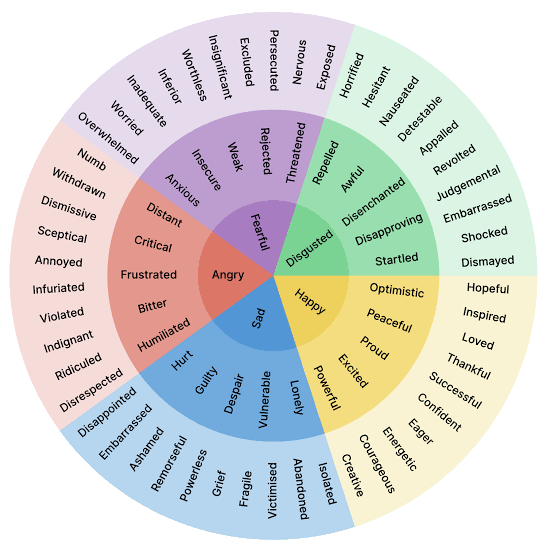
The Feelings Wheel:
Exploring Family Rules, Emotional Beliefs & Relationships
Understanding the feelings we learned were allowed, expected, or off-limits
Our relationships with emotions often begin long before we have the language to identify them. Growing up, we learn—sometimes directly, sometimes indirectly—which feelings are welcomed, which are expected, which are misunderstood, and which are better left unspoken.
In some families, anger might be considered disrespectful, sadness might be met with discomfort, and happiness might be encouraged. In others, anger may be the only emotion that feels safe to express, while vulnerability, fear, or sadness remain unspoken.
We may learn that being agreeable keeps the peace, that expressing disappointment makes us difficult, that crying is a sign of weakness, or that taking care of everyone else's feelings is our responsibility.
These messages can become unspoken emotional rules that shape how we understand ourselves and navigate relationships. They may influence which feelings we allow ourselves to experience, how comfortable we are expressing them, and how we respond when other people express emotions that feel unfamiliar or uncomfortable.
The feelings wheel can help us slow down, expand our emotional vocabulary, and explore the associations, beliefs, and judgments we have developed around different feelings.
This exercise is an invitation to get curious—not to judge your family, yourself, or the ways you learned to cope.
Part 1: Identify the Emotional Rules You Grew Up With
Think about the family, household, or environments in which you grew up. Consider both the messages you heard directly and the things you learned by observing how others responded to emotions.
For each feeling, consider:
Was this feeling allowed to be expressed?
Was it welcomed, encouraged, ignored, minimized, or punished?
Was there a particular person who was allowed to express it?
Did the rules differ depending on someone's age, gender, role, or position in the family?
What happened when someone expressed this feeling?
Did you learn to hide, exaggerate, suppress, or redirect this feeling?
Consider the following categories:
Allowed: Feelings that could be expressed openly without significant consequences.
Expected or needed: Feelings you were expected to show, or emotions you learned you needed to express to meet others' expectations. For example, being happy, grateful, agreeable, calm, or understanding.
Discouraged or minimized: Feelings that might be tolerated but were dismissed, misunderstood, or met with discomfort.
Taboo or unsafe: Feelings that were not permitted, openly expressed, or acknowledged. Expressing them may have led to criticism, conflict, withdrawal, punishment, or shame.
Unspoken or unrecognized: Feelings that may not have had a name in your family, even if they were present beneath the surface.
Part 2: Explore Your Associations With Feelings
Using the feelings wheel, choose a few emotions that stand out to you. You might choose feelings you experience frequently, feelings that are difficult to identify, or feelings that bring up discomfort when you imagine expressing them.
For each feeling, explore the following:
What does this feeling mean to me? What words, memories, images, or experiences do I associate with it?
What did I learn about this feeling? What did my family or early environments communicate about people who experienced or expressed it?
What judgments do I attach to it? Do I view this feeling as weak, selfish, dramatic, embarrassing, dangerous, inappropriate, or unacceptable?
What do I believe this feeling says about me? For example, if I feel angry, does that mean I'm difficult? If I feel sad, does that mean I'm incapable? If I feel jealous, does that mean I'm a bad person?
What do I assume about other people when they express this feeling? Do I become uncomfortable, defensive, dismissive, worried, or judgmental?
What do I do when this feeling comes up? Do I express it, suppress it, intellectualize it, avoid it, minimize it, or direct it somewhere else?
What might this feeling be communicating or asking for? Is there a need, boundary, fear, loss, desire, or unmet expectation underneath it?
Part 3: Notice How These Rules Show Up in Relationships
The emotional rules we learn growing up do not necessarily stay in childhood. They can follow us into friendships, romantic relationships, parenting, professional environments, and our relationship with ourselves.
Consider:
Do I feel responsible for managing other people's emotions?
Do I feel guilty when someone is disappointed in me?
Is it difficult to express anger, sadness, jealousy, fear, or disappointment?
Do I interpret someone else's emotional expression as a reflection of how they feel about me?
Do I become uncomfortable when other people express feelings I was discouraged from showing?
Do I minimize my own feelings while making room for everyone else's?
Do I expect others to know what I need without having to communicate it?
Do I judge myself or others for having certain emotional reactions?
Do I confuse having a feeling with acting on that feeling?
Notice whether any of these patterns feel familiar. You are not necessarily choosing these responses consciously; some may be learned ways of maintaining connection, avoiding conflict, or protecting yourself.
Part 4: Separate the Feeling From the Judgment
One important distinction is that having a feeling is not the same as acting on it.
Feeling angry does not mean you are going to hurt someone. Feeling jealous does not make you a bad person. Feeling resentment does not mean you don't love someone. Feeling disappointed does not mean you are ungrateful.
Emotions are experiences, not character assessments. They can provide information about our needs, expectations, boundaries, experiences, and relationships. They do not automatically tell us what is true, what someone else intended, or what action we should take.
Try completing these statements:
When I feel __________, I tend to tell myself __________.
I learned that people who feel __________ are __________.
When someone else expresses __________, I tend to assume __________.
I feel most uncomfortable expressing __________ because __________.
I wish I had been allowed to feel or express __________.
I want to practice allowing myself to feel __________ without judging myself for it.
Part 5: Decide Which Emotional Rules You Want to Keep, Question, or Change
Not every emotional rule you learned needs to be discarded. Some may reflect values you still hold, while others may no longer serve you or your relationships.
Consider:
Rules I want to keep: What messages about emotional expression, empathy, communication, or accountability still feel meaningful to me?
Rules I want to question: What beliefs have I accepted without considering whether they are actually true or helpful?
Rules I want to change: What feelings do I want to make more room for? What would it look like to express them safely and constructively?
New emotional permissions: What would I like to give myself permission to feel, communicate, or ask for?
You might begin with:
I am allowed to feel __________ without __________.
I can acknowledge someone else's feelings without taking responsibility for fixing them.
I can express __________ while still being respectful of others.
Someone else's feelings do not automatically mean I have done something wrong.
I can experience conflicting feelings at the same time.
I can choose how I respond to a feeling without needing to deny that I have it.
A Final Reflection
The goal of this exercise is not to become comfortable with every emotion overnight or to eliminate difficult feelings. It is to develop a more flexible, compassionate relationship with your emotional experiences.
You can begin to recognize which beliefs and judgments were learned, which ones you still identify with, and which ones you might want to approach differently.
You are allowed to have feelings that other people don't understand. You are allowed to experience emotions that are complicated, contradictory, or inconvenient. And you can learn to make room for your own emotional experiences while respecting the emotional experiences of others.
You don't have to agree with every feeling, act on every feeling, or make every feeling go away to acknowledge that it exists.